Mid-Summer Bermuda and St. Augustine Mowing in San Antonio: Once a Week Is Not Enough
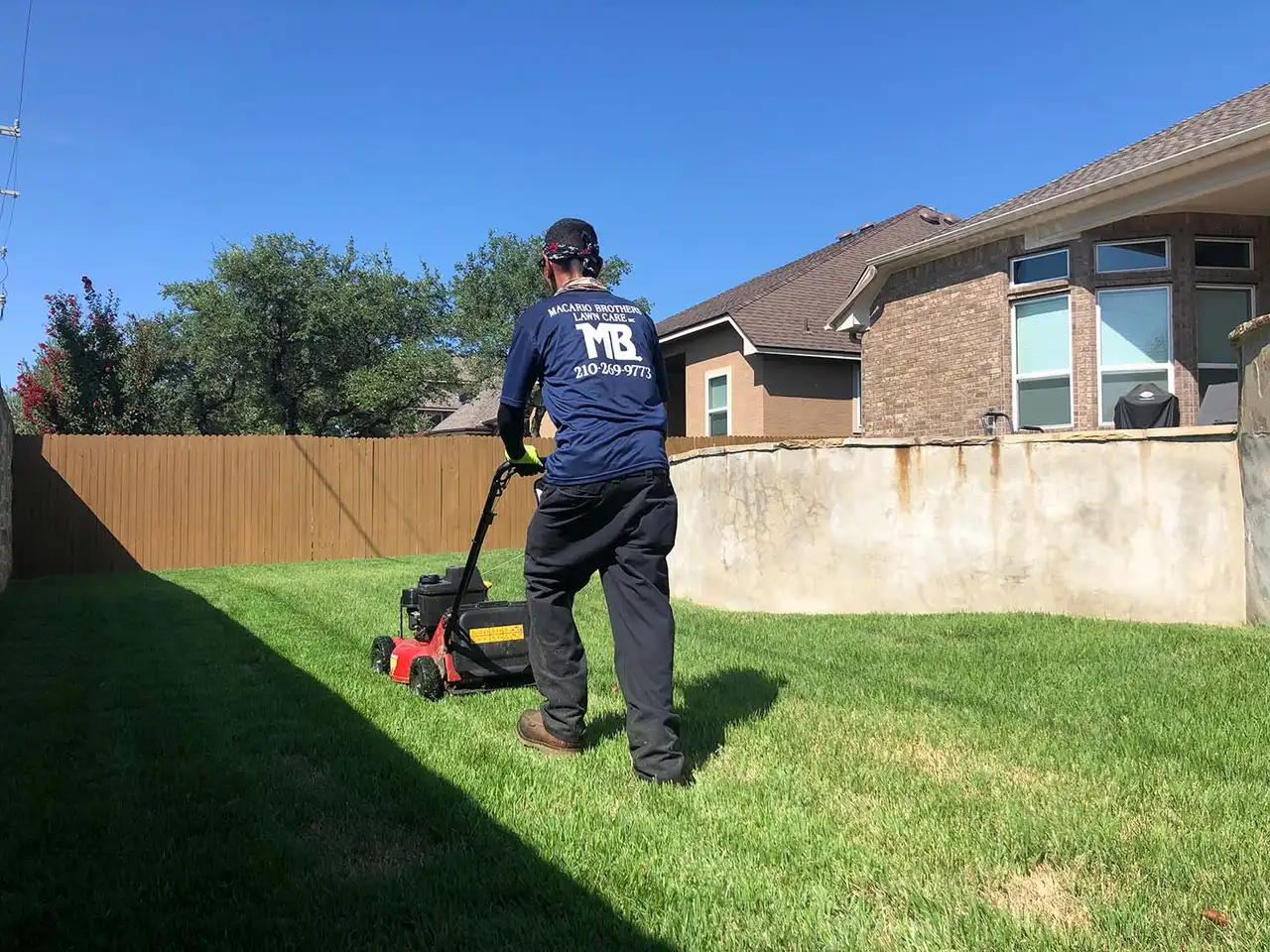
Macario Brothers Lawn Care • July 2026 • San Antonio, TX
Short Answer: A San Antonio Bermuda lawn under irrigation doubles its growth rate in July compared to May. A weekly mow that worked in spring removes more than a third of the blade length each visit by mid-summer, which stresses the plant and accelerates browning. The right schedule for irrigated warm-season lawns in San Antonio July is every five days for Bermuda and every six to seven days for St. Augustine, with mowing height raised a notch from spring settings. The cost of the extra visit pays itself back in healthier turf and fewer rescue calls.
Every year in July we hear the same comment on residential walkthroughs. "The lawn just keeps getting away from me." Homeowners are doing what they always did. The schedule that worked April and May suddenly does not. The grass looks ragged within a few days of the last mow. Patches start to brown. Weed pressure picks up. The instinct is to assume something is wrong with the lawn. Usually nothing is wrong with the lawn. The issue is that the lawn is doing what warm-season grasses do in July, which is grow at a rate that overruns a once-a-week mowing schedule.
This blog walks through why that happens, what the right schedule looks like for Bermuda and St. Augustine in our specific climate, the height adjustments that matter, and what changes when you keep up with the growth instead of fighting it.
Why Warm-Season Lawns Grow Faster in July
Bermuda is a C4 grass. Its photosynthetic machinery is optimized for high temperature and high light. May in San Antonio is plenty warm enough for Bermuda to grow well, but July is closer to ideal. Daytime temperatures in the mid to upper 90s, soil temperatures in the upper 80s, long photoperiod, and active irrigation push Bermuda growth to its annual peak. A lawn that gained one inch of height per week in May routinely gains two inches per week in July if water is available.
St. Augustine grows somewhat slower than Bermuda but the curve is similar. The peak growth window for St. Augustine in San Antonio is late June through early August. Irrigated St. Augustine in this window adds about an inch and a half of height per week, which is roughly 50 percent more than its spring rate.
Zoysia is the slowest grower of the three warm-season grasses we maintain in San Antonio, but even Zoysia speeds up in July. A Zoysia lawn under irrigation might add an inch a week through July compared to half an inch in May.
The implication for mowing is straightforward. If the grass is growing at twice the spring rate, a weekly mowing schedule produces a clipping that is twice as long. That length difference is the variable that makes once a week stop working.
The One-Third Rule and Why It Matters
The most important rule in mowing is to never remove more than one third of the blade length at a single cutting. This is not an arbitrary number. The grass plant needs leaf tissue to photosynthesize, and removing too much leaf at one time forces the plant to either pull from root reserves or stop growing. Either response stresses the lawn.
The math gets uncomfortable in July. A homeowner who mows St. Augustine at 3.5 inches on Sunday and lets it grow until the next Sunday will be cutting from roughly 5 inches back to 3.5 inches if the lawn is irrigated. That is removing 30 percent of the blade length, which is right at the threshold of the one-third rule. If the lawn grew an inch and a half between cuts (which is normal in July) then the homeowner is cutting from 5 inches to 3.5 inches and removing the full one and a half inches, which works out to 30 percent and is still acceptable. But if the homeowner missed a week because of rain or vacation, the math goes south fast. The grass is now at 6.5 inches, and cutting back to 3.5 inches is more than 45 percent of the blade length. That stress shows up as yellowing within 24 to 48 hours.
A Bermuda lawn maintained at 2 inches has even less margin. Adding two inches of growth between mowings puts the canopy at 4 inches, and cutting back to 2 inches removes 50 percent of the blade. That is a recipe for the brown shock that homeowners often call "lawn burn" without realizing the burn was mechanical, not chemical.
The Right Frequency for San Antonio July
For irrigated Bermuda lawns through July, mowing every five days is the schedule we recommend on properties we maintain. Some lawns can stretch to six days. Lawns with heavy irrigation or rich soil sometimes need every four days during the worst of the growth peak.
For irrigated St. Augustine lawns, every six to seven days is the right rhythm. The slower growth rate compared to Bermuda gives a little more flexibility, but not as much as homeowners expect.
For Zoysia lawns, every seven days works most of the time in July. Zoysia is the most forgiving of the three on schedule.
For non-irrigated lawns or lawns under watering restrictions, the schedule is different because the growth rate is lower. A non-irrigated Bermuda lawn in July might grow slowly enough that every 10 to 14 days is appropriate. The lower growth rate is the lawn rationing its energy under drought stress, and the appropriate mowing schedule honors that.
The Height Adjustment That Matters
The other change that matters in July is mowing height. The right summer height is one notch higher than the spring height for the same grass.
Bermuda that ran at 1.5 to 2 inches in spring should run at 2 to 2.5 inches in July. Some Bermuda varieties tolerate higher cuts. We sometimes set up to 3 inches on lawns with particularly thin soil or heavy heat exposure.
St. Augustine that ran at 3 inches in spring should run at 3.5 to 4 inches in July. Floratam (the dominant St. Augustine variety in San Antonio) actually benefits more from a tall summer cut than most homeowners realize. The taller canopy shades the soil, lowers crown temperature, reduces water loss to evaporation, and shades out weed pressure substantially.
Zoysia that ran at 1.5 to 2 inches in spring should run at 2 to 2.5 inches in July. The taller cut helps Zoysia handle heat the same way it helps Bermuda.
The reason a taller cut helps in summer is that the leaf canopy provides shade for the soil. Soil temperature at the crown level under a 2 inch Bermuda canopy on a 95 degree day can reach 110 degrees. The same lawn cut at 3 inches keeps crown temperature 8 to 12 degrees lower. That difference is the line between healthy crowns and crowns that start to burn.
Blade Sharpness and Why It Matters More in July
Sharp blades cut. Dull blades tear. The difference matters all year but it matters more in July because the heat stress amplifies the consequence of a poor cut.
A clean cut from a sharp blade seals quickly. The leaf tissue heals within hours. Water loss from the cut surface is minimal. A torn cut from a dull blade leaves a frayed edge that takes days to heal. Water loss from frayed tissue is significant. The torn edges turn white or tan within 24 hours and contribute to the overall ragged appearance of a lawn that looks worse a few days after a mow than it should.
We sharpen our mower blades every 25 to 30 hours of operation, which on a commercial schedule means weekly or biweekly. For homeowners, a sharpening every two to four weeks during peak growth season is appropriate. A second set of blades on hand makes the swap easier.
Clipping Management Through July
Mulching the clippings back into the lawn is the right call for most San Antonio lawns most of the time. Grass clippings are about 4 percent nitrogen by dry weight. Returning them to the lawn over a season can substitute for one to two fertilizer applications. The clippings break down within a week or two if the cut length was appropriate.
The exception is when the clippings are too long because the lawn got away from the schedule. Long heavy clippings can mat on top of the canopy and smother the grass underneath. If you skipped a week and you are cutting more than the one-third rule allows, bag the first cut and return to mulching on the next cut once the lawn is back at proper height.
Bagging clippings every cut all summer removes nutrients that the lawn needs and forces you to make up the difference with fertilizer. Some homeowners prefer the look of a freshly bagged lawn enough to accept the trade. That is a reasonable choice as long as the math works for the fertility plan.
Mowing Patterns That Reduce Stress
A few mowing pattern choices help the lawn through summer. Vary the direction of the mow across visits. Mowing the same direction every week creates ruts where the wheels run and trains the grass to lean in one direction. Alternating north-south one week and east-west the next gives a more even cut and avoids the visible wheel tracks that some homeowners mistake for irrigation problems.
Avoid sharp turns at the same point every mow. The pivot point of a zero-turn mower scuffs the turf if you pivot in the same spot repeatedly. Move the turning point each cut.
Mow in the cooler part of the day when possible. Early morning is best. Evening also works. Mid-afternoon mowing on a 100 degree day stresses both the lawn and the operator. For homeowners doing their own mowing in summer, the morning slot before 10 is the sweet spot.
What Happens When the Schedule Gets Away From You
Every summer some week falls apart. Rain, travel, illness, equipment breakdown. The lawn that was supposed to get mowed Sunday gets mowed Friday or the next Tuesday. The grass is too tall and the standard cut would violate the one-third rule.
The recovery plan is a two-cut approach. First cut at the highest setting on the mower (or one notch above your normal summer height). Then wait two to three days and cut again at your normal summer height. The two-cut approach removes the overall length you need to remove without taking more than a third in any single cut. The lawn will look uneven for about a week and then recover.
Do not skip and just cut back to normal height in one pass. The shock will be visible for two to three weeks and will set the lawn back further than the original missed week did.
Mowing on Watering Restriction Days
San Antonio enforces watering restrictions through the SAWS conservation program. The schedule varies by stage. Mowing schedule does not change based on water restrictions, but the irrigation schedule does, which affects how fast the lawn grows and how forgiving the mowing schedule is.
Under Stage 2 restrictions or tighter, lawns grow slower because of the reduced water. A weekly mowing schedule that was insufficient under normal conditions may be sufficient under restriction. We adjust our service frequency on lawns we maintain based on actual lawn growth rather than calendar, which sometimes means stretching to every eight or nine days during heavy restriction periods.
Do not stop mowing because of water restrictions. Even a slower-growing lawn still grows and still needs the cut to stay dense and to keep weed pressure down.
The Cost Math on More Frequent Mowing
Some homeowners look at the difference between weekly and every-five-days mowing and see it as a 40 percent cost increase, which it roughly is on the per-visit price. The math that actually applies includes the downstream cost of underservicing the lawn.
A weekly-mowed lawn in July typically requires more rescue work over the rest of the season. Stress from over-cut leaves shows up as thinning that allows weed encroachment. Weed control treatments cost money. Repaired bare spots cost more money. Sodding from severe decline costs much more money.
Across most of the residential properties we maintain, the homeowners who pay the small premium for appropriate summer service frequency end up spending less on lawn services overall. The extra mow per month in July and August is the cheapest insurance against decline they can buy.
Frequently Asked Questions
What if I cannot afford every five days for Bermuda?
Stretch to every seven days but compensate with a higher summer mowing height. A Bermuda lawn at 3 inches cut weekly is better off than the same lawn cut at 2 inches twice a week. The taller canopy gives more buffer against the one-third rule violation when growth runs ahead of the schedule.
Can I mow when the lawn is wet?
Avoid it when possible. Wet grass clumps, smothers the canopy underneath, and produces an uneven cut. If you have to mow wet because of weather, raise the deck a notch and bag the clippings for that one cut to prevent matting.
Should I mow before or after watering?
Mow on days when watering already happened in the morning and the canopy is dry by the time you get to it. The early morning watering followed by mid-morning mowing pattern is ideal. Mowing first thing on a dry canopy and watering after also works.
What if my mowing service only offers weekly?
Ask whether they can switch you to every five days for July and August only and return to weekly in September. Most commercial services can accommodate the seasonal change. If yours cannot, consider a service that can. The summer mow frequency makes more difference to lawn health than any other single variable on a maintenance program.
What to Do Next
If your lawn looks ragged within three or four days of mowing through July, the schedule is the first place to adjust. Tighten the frequency, raise the height a notch, sharpen the blades, and stick with the new rhythm for four weeks. The lawn will respond visibly within that window.
If you want to put the schedule in our hands, call us at 210-269-9773 or visit macariobrotherslawncare.com. Our maintenance program adjusts mowing frequency to the season, which means more visits in July and fewer in November, with the goal of keeping the lawn at appropriate length without overshooting the one-third rule. We serve San Antonio and the surrounding communities. As a family business we treat every lawn the way we treat our own. Cut at the right height, on the right schedule, with sharp blades. The simple things, done consistently, are what produce the best lawns on the block.