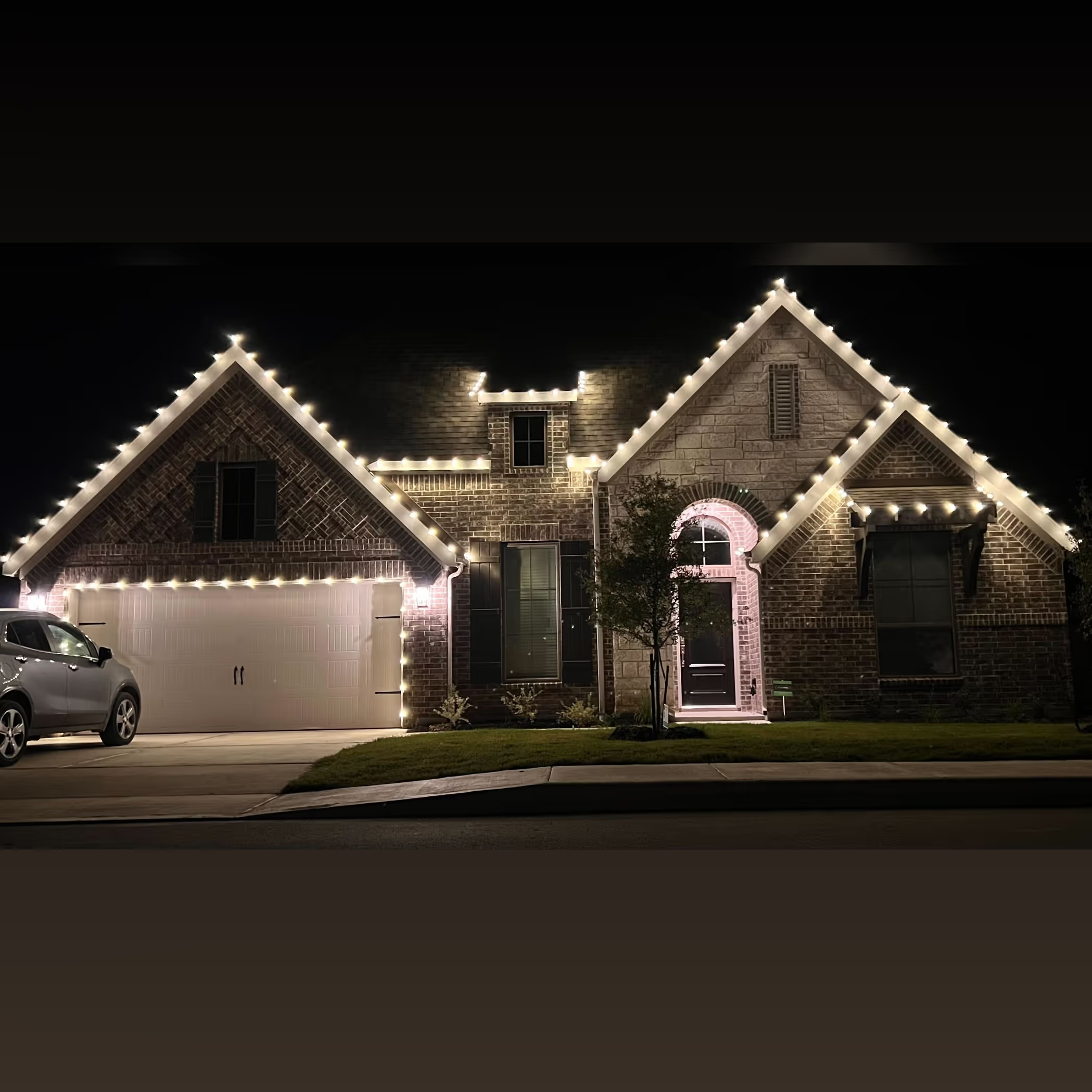
Christmas Light Installation
What Does Christmas Light Installation Cost in San Antonio?
Macario Brothers Lawn Care • October 2026 • San Antonio, TX • 7 min read

Short Answer: Professional holiday lighting in San Antonio is generally priced per linear foot for rooflines and per tree for wrapping. A modest roofline only install on a single story home commonly runs $400 to $900. A larger two story home with entry accents and a wrapped tree typically lands between $1,200 and $3,000, and elaborate displays on large properties go well above that. Pricing normally includes materials, installation, service during the season, and takedown and storage, which is why it compares differently to a do it yourself total than people expect.
Holiday lighting quotes surprise people, usually because the comparison in their head is the cost of light strings at a big box store. That is not what is being priced, and understanding what is actually included makes the numbers make more sense.
Here is what professional installation costs around San Antonio, what drives a quote up or down, and an honest comparison against handling it yourself.
How It Gets Priced
Rooflines are generally quoted per linear foot. The installer measures the runs to be lit, and the price reflects both material and the labor of installing at height along that distance.
Trees are priced individually, because a tree is a variable rather than a measurement. A small ornamental with a wrapped trunk is a modest add. A mature live oak wrapped through the major limbs is a significant portion of a total.
Accent elements including wreaths, garland, entry columns, and pathway lighting are typically itemized as well.
For a general sense of scale in our market, a roofline only install on a single story home commonly runs $400 to $900. A two story home with entry accents and a wrapped tree generally lands between $1,200 and $3,000. Large properties with multiple mature trees and extensive rooflines go above that range.
Those figures assume a full service arrangement including materials, installation, in season service, and takedown, which is the standard structure in this industry.
What Drives a Quote Up
Five factors account for most of the variation between a modest estimate and a large one.
Height is first and it is mostly about safety and time. Single story work is straightforward. Two story rooflines require taller ladders, more setup and repositioning, and more caution, and all of that is time on the job.
Roof pitch compounds it. A steep roof slows everything down and increases the safety requirements, and a very steep pitch may require additional equipment or fall protection.
Architectural complexity matters more than square footage. A simple rectangular roofline is fast. Multiple gables, dormers, varied heights, and detailed trim all mean more measuring, more cutting, and more transitions, which is why two houses of similar size can quote quite differently.
Trees are frequently the largest single line, and mature live oaks in particular. Wrapping consumes substantial material and hours, and tree size drives that more than anything else on a San Antonio property.
Access affects it as well. Landscaping beds tight against the house, fencing, gates too narrow for equipment, and limited places to safely set a ladder all slow the work. A crew that has to carry material around a property rather than working from the driveway spends real time doing it.
What Should Be Included
This is where quotes differ in ways the headline number does not reveal, and it is worth confirming item by item.
Materials should be provided by the installer and should be commercial grade rather than retail product. In most arrangements those materials remain the installer's property and are reused across seasons, which is part of why the first year and subsequent years can be priced differently.
Custom fitting should be standard. Lights cut to length for your specific rooflines look considerably better than retail strings run end to end with slack doubled back at the finish.
Service during the season is the item people most often discover is missing. Something will go out at some point between Thanksgiving and New Year, and whether a crew returns to fix it at no additional charge is a meaningful difference in value.
Takedown and storage close the arrangement. Removal in January should be included, and if the installer stores the materials, your garage stays free and the product gets maintained between seasons.
Timers and power management should be part of the install rather than left for you to sort out. On a larger display this matters, because distributing runs across circuits so nothing trips is part of the design rather than an afterthought.
Comparing Against Doing It Yourself
Worth laying out honestly, because the comparison is not as lopsided as either side usually claims.
Retail light strings, clips, timers, and extension cords for a moderate display run a few hundred dollars, and quality product costs more than the cheapest option. That material is yours, which means the cost is front loaded rather than recurring, though consumer grade strings frequently do not survive many seasons in our sun.
The time commitment is the larger factor. A first year install on a two story home is a full weekend for most people, and that assumes things go smoothly. Takedown in January is another day, and storage occupies real space.
Safety is the part we would not gloss over. Ladder work on a two story roofline, particularly on steep pitch, is genuinely where people get hurt doing home projects. Falls from ladders during holiday decorating send people to emergency rooms every December. That risk is a real part of the comparison even though it does not appear on an invoice.
Where do it yourself makes clear sense is a single story home with simple rooflines and a homeowner who does not mind the work. Where hiring out makes sense is height, complexity, large trees, or a household without a free weekend in November.
Permanent Lighting as an Alternative
Worth mentioning because it comes up and because it changes the math over time.
Permanently installed track lighting systems mount along the roofline and stay year round, with individually controllable LED fixtures that can produce holiday colors in December and subdued accent lighting the rest of the year.
The installation cost is substantially higher than a season of traditional lighting, generally by a multiple. The tradeoff is that there is no annual install and removal, no storage, and the system serves other holidays and everyday accent lighting.
The break even depends on how many seasons you stay and how much you would otherwise spend annually. For a homeowner planning to remain in the house long term who reliably decorates every year, it can pencil out. For someone who decorates occasionally or expects to move, traditional seasonal installation is the better value.
It also does not address trees. Wrapped oaks still require seasonal work regardless of what is on the roofline.
Where Homeowners Waste Money
A few patterns come up repeatedly and each is avoidable.
Buying cheap strings repeatedly is the most common. Replacing consumer grade product every year or two costs more across five seasons than better material would have.
Mixing bulb colors and temperatures across a property is the aesthetic version of the same problem. It costs nothing to avoid and it is the difference between a display that looks coordinated and one that looks accumulated.
Overloading circuits leads to tripped breakers and frustration, and in the worst cases to damaged cords. Planning the load is free if you do it before buying.
And booking late frequently costs money, because remaining availability tends to be limited and rushed scheduling serves nobody well. The season here runs roughly five weeks, and the properties booked in October are the ones that get the dates they wanted.
What to Do Next
Define your scope before requesting quotes. Roofline only, roofline plus entry, or a full display including trees. Estimates are only comparable when they cover the same work.
Measure your rooflines roughly, or at least know whether you are single or two story and how complex the architecture is. That gives any company a realistic starting point over the phone.
Count your trees and note their size, particularly mature live oaks, since they are usually the largest single variable in a San Antonio quote. A photo taken from the street helps a company estimate accurately before anyone drives out.
When comparing quotes, confirm the four inclusions. Materials and whose they are, custom fitting, service during the season, and takedown and storage. A cheaper quote missing two of those is not cheaper.
To get a quote for this season, call Macario Brothers Lawn Care at 210-269-9773 or visit macariobrotherslawncare.com. We are a family owned business serving San Antonio, and October is the right time to get on the calendar.